


RebusFarm Alternatives in 2026: When to Switch and What to Check
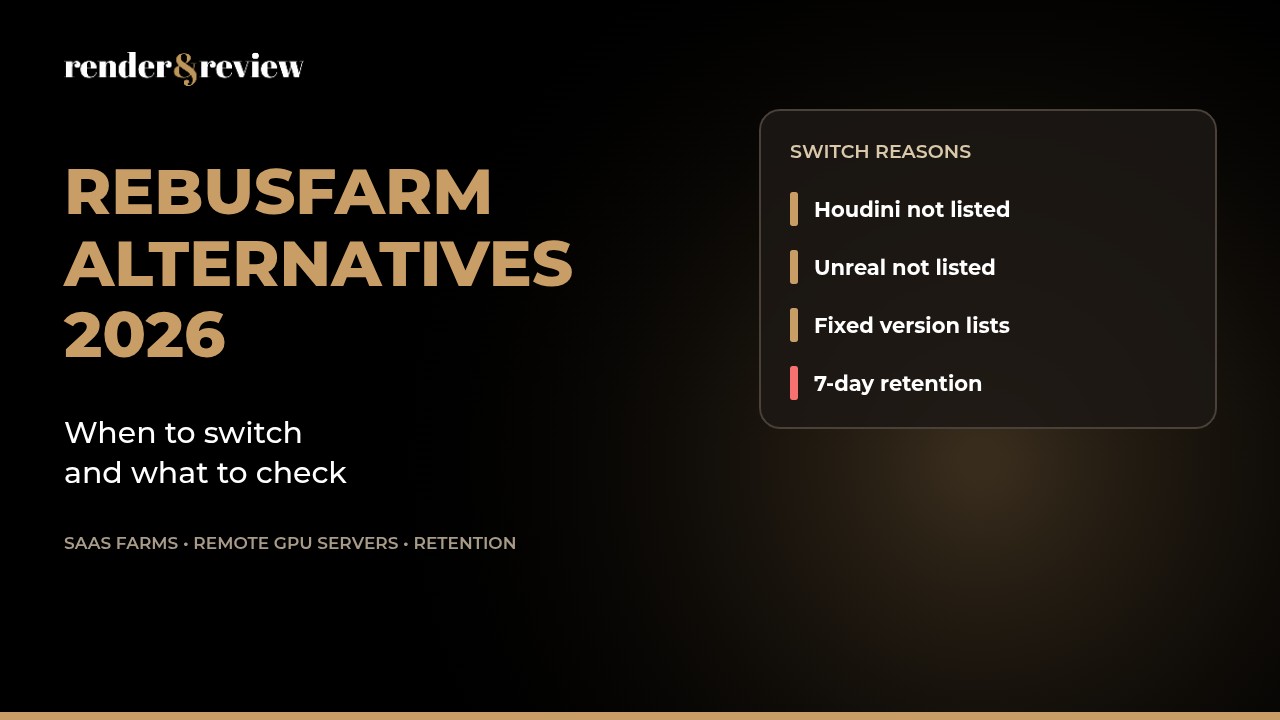
RebusFarm alternatives make sense when your host, renderer or data needs fall outside what RebusFarm lists, rather than as a hunt for a lower rate.
- RebusFarm’s strengths: Farminizer submission from inside 3ds Max, Cinema 4D, Maya and Blender, RenderPoints that never expire, free upload and storage, ISO 27001 and a German data centre.
- Common switch reasons: Houdini, Karma or Unreal Engine jobs, which RebusFarm does not list, and GPU scenes where you need published VRAM figures.
- Watch the clock: RebusFarm deletes results seven days after delivery, shorter than the 20 days at Fox or the 28 days at GarageFarm.
- Managed alternatives: Fox Renderfarm, GarageFarm, GridMarkets and RANCH Computing each cover a different gap.
- Remote GPU option: iRender rents whole machines with 1 to 8 RTX 4090 or RTX 5090 cards where you install what the scene needs.
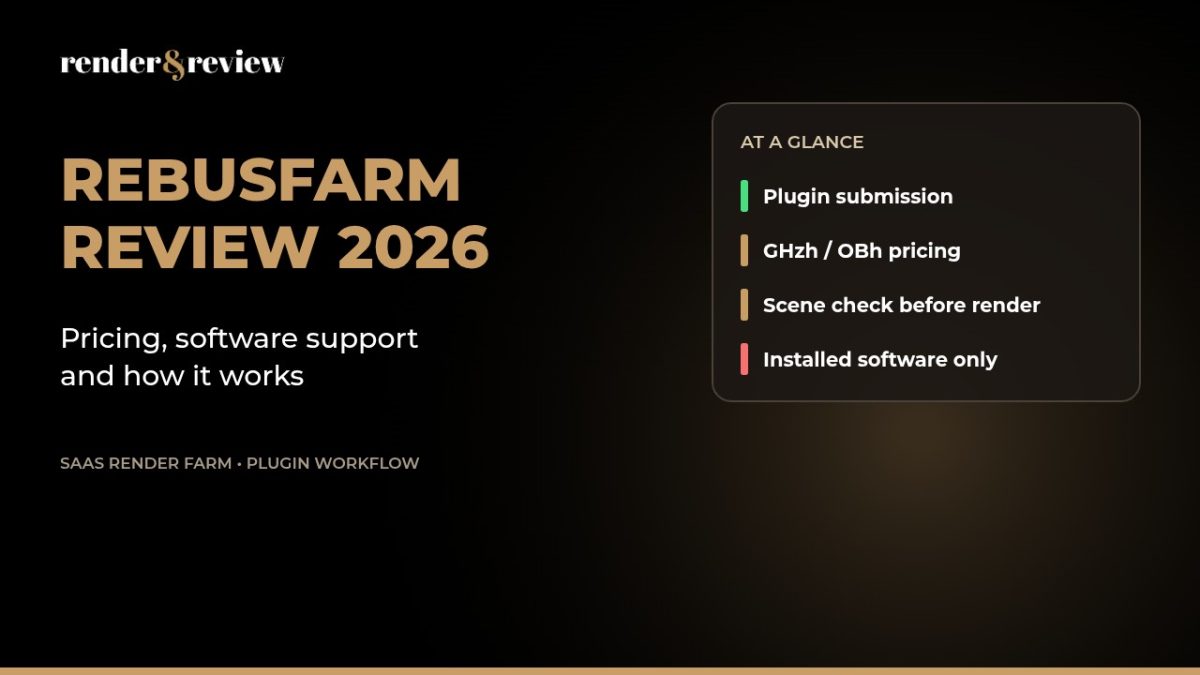
RebusFarm, based in Cologne, says it has served 3D artists for 20 years, and its Farminizer plugin lets 3ds Max and Cinema 4D users submit from inside the host. Looking for RebusFarm alternatives usually means a specific gap: a host it does not list, a renderer build outside its version range, or results you need to keep longer than its retention window. This guide starts from those gaps and maps each one to a type of service that closes it.
Prices, software lists and policies below come from each provider’s own pages, read on 23 November 2026. Lists change often, so confirm the exact version you need before a deadline job. For a full description of RebusFarm itself, see our RebusFarm review.
Table of Contents
1. What RebusFarm Does Well
RebusFarm’s workflow runs through the Rebus Farminizer, a plugin inside each supported 3D application. Sending a job triggers a scene check, and with Autostart enabled the render begins straight away; RebusFarm says jobs usually start within seconds. Its version support for the hosts it covers is deep: the 3ds Max page lists releases from 2013 to 2027 and around 50 plugins, from Forest Pack and RailClone to Phoenix and FumeFX.
RebusFarm Terms at a Glance
From RebusFarm’s buy, FAQ and contractual pages, read 23 November 2026.
| Item | Terms | What it means |
|---|---|---|
| CPU rendering~|1.20 euro cents per GHz-hour:|1.41 US cents on the US page | Cost scales with CPU speed and time | |
| GPU rendering~|0.45 euro cents per OB-hour:|0.53 US cents on the US page | Cost scales with OctaneBench score and time | |
| RenderPoints+|Never expire:|no minimum turnover | Prepaid credit you can keep | |
| Transfers and storage+|Free:|upload, download and storage | Only engine time is charged | |
| Discounts+|Up to 60 percent volume:|50 percent for students | Larger purchases lower the rate | |
| Result retention-|7 days:|then irrevocably deleted | Download promptly |
2. Why Artists Look for RebusFarm Alternatives
2.1 Houdini, Karma and Unreal Engine are not listed
RebusFarm’s software page covers 3ds Max, Cinema 4D, Maya, Blender, Modo, LightWave, SketchUp, Rhino and Softimage, with V-Ray, Corona, Redshift, Octane, Arnold and Maxwell. Houdini, Karma and Unreal Engine do not appear on its software or FAQ pages, and neither do KeyShot, D5 Render, Lumion or Twinmotion. For those tools you need a farm that lists them or a machine you set up yourself.
2.2 Fixed version lists
Managed farms install and test specific builds. RebusFarm’s 3ds Max page, for example, supports only the last stable Octane release and four Maxwell builds. If your scene depends on an older renderer or a plugin release not on the list, ask support first; otherwise a farm with a different list, or a machine where you install the build, is the fix. Our pre-flight guide covers the version checks.
2.3 GPU hardware details
RebusFarm bills GPU time per OB-hour and its homepage names the Quadro RTX 6000 for GPU rendering, but it publishes no VRAM figures or GPUs per node. For heavy GPU scenes where VRAM decides whether a frame renders at all, farms that publish their cards make planning easier.
2.4 Seven-day result retention
RebusFarm’s contractual terms say render results are irrevocably deleted seven days after they are provided. Studios that collect results in batches or need a longer buffer may prefer a provider with a longer window.
3. RebusFarm Alternatives Compared
There is no single best render farm, only the one that fits your project. The farms below are listed in alphabetical order and grouped by service model: managed SaaS farms first, then remote GPU servers (IaaS).
RebusFarm Alternatives at a Glance
Billing, hardware and software focus as published by each provider, read 23 November 2026.
| Provider | Billing unit | Hardware listed | Strength | Watch for |
|---|---|---|---|---|
| Managed SaaS farms: upload the scene and the farm renders it with its own installed software. Suits artists who want the least setup and use supported software versions and plugins. | ||||
| Fox RenderfarmSaaS | Per node-hour: CPU $0.734 to $1.224 | GPU models not listed | Houdini and Unreal: on the software list | Files deleted after 20 days |
| GarageFarmSaaS | GHz-hour and OB-hour: three priority tiers | Up to 96GB VRAM nodes | Large VRAM: on Medium and High | Houdini only via exports |
| GridMarketsSaaS | Per machine-hour: billed per second | Not listed publicly | Houdini depth: licences included | Economy tier capped at 5 machines |
| RANCH ComputingSaaS | OB-hour and GHz-hour: three priority tiers | RTX 2080 Ti to RTX 5090 | Karma XPU listed: Houdini 19.5 to 22 | Max 32GB VRAM per card |
| Remote GPU servers (IaaS): rent a whole machine and install your own software. Suits custom versions, unusual plugins, real-time engines and interactive work. | ||||
| iRenderIaaS | Per machine-hour: from $8.20 (RTX 4090) | 1 to 8 RTX 4090 or RTX 5090 | Your own software: any version or plugin | You manage setup and shutdown |
3.1 Fox Renderfarm
Fox Renderfarm lists Houdini 21 or later with Mantra, Karma, Redshift and Arnold, and Unreal Engine from 4.27.2 with Movie Render Queue, Lumen, Nanite and the Path Tracer, which covers two of RebusFarm’s biggest gaps. It bills CPU per node-hour, from $1.224 on its Ordinary plan down to $0.734 once more than $10,000 has been recharged, and does not charge for failed renders. Fox states it is ISO 27001 certified and TPN accredited.
3.2 GarageFarm
GarageFarm prices CPU and GPU work in GHz-hours and OB-hours across Low, Medium and High priority, with GPU nodes of up to 96GB of VRAM on Medium and High, which suits GPU scenes too large for 24GB or 32GB cards. Its host list overlaps with RebusFarm’s, so it is an alternative mainly for VRAM, support and workflow rather than for Houdini or Unreal.
3.3 GridMarkets
GridMarkets sells credits at US$1 and bills machine time per second with transfer, storage and renderer licences included. It lists Houdini with Solaris, Karma and Mantra, plus Unreal Engine, Maya, 3ds Max, Cinema 4D and Blender. New accounts get five free credits, and the Economy tier is capped at five concurrent machines, with more on Standard and Rush.
3.4 RANCH Computing
RANCH Computing lists Houdini builds from 19.5 to 22.0 with Karma CPU, Karma XPU, Mantra, Redshift, Arnold, V-Ray and RenderMan, and picks the GPU or CPU farm automatically from the render engine. Its GPU farm runs RTX 2080 Ti to RTX 5090 cards, so VRAM tops out at 32GB per card. It gives €30 of trial credit.
3.5 iRender (remote GPU servers)
iRender rents a whole Windows machine with 1, 2, 4 or 8 RTX 4090 or RTX 5090 cards, reached by remote desktop. iRender’s machines come with Cinema 4D, Redshift, Octane and Blender pre-installed in their latest versions (licences come pre-activated only for iRender Prime members; other users activate their own); Houdini, Unreal, older versions and plugins you install yourself, and the machine keeps that setup between sessions. Its price page lists $8.20 per hour for one RTX 4090 and $10.80 for one RTX 5090. The catch is discipline: billing keeps running until you press Shutdown in its app or web panel, so a machine left on after the last frame keeps costing money.
On data protection, iRender states that its data center is rated Uptime Tier III and holds ISO 27001 (BS7799), ISO 20000 (ITIL) and ISO 9001:2000 certification. Its terms say client projects are kept confidential and an NDA can be signed on request. We have not verified these claims independently.
4. Matching the Alternative to Your Workflow
Which Service Type Fits Which Need
General guidance; confirm exact versions with each provider.
| Your situation | Better fit | Why |
|---|---|---|
| 3ds Max or C4D on a listed version+|Stay on RebusFarm:| | Mature plugin workflow and deep version support | |
| Houdini with Karma or Solaris~|Houdini-capable farm or remote server:| | RebusFarm does not list Houdini | |
| Unreal Engine sequences~|Farm that lists Unreal or remote server:| | Interactive control may matter | |
| D5, Lumion or Twinmotion+|Remote GPU server:| | Needs a live GPU machine | |
| GPU scene above 32GB~|Farm with large-VRAM nodes:| | VRAM decides if the frame renders | |
| Results collected weeks later~|Longer retention or own storage:| | RebusFarm deletes after 7 days |
For the wider picture, read SaaS vs IaaS render farms for VFX and render farm alternatives compared.
5. Data Retention and Cost: The Details That Bite
Retention is easy to overlook until results disappear. The windows below come from each provider’s terms; GarageFarm guarantees only the first seven of its 28 days, and iRender’s figure is for data on its sync drives for regular users.
On cost, RebusFarm’s GHz-hour and OB-hour rates do not compare directly with node-hour or machine-hour prices elsewhere. Render the same frames on each shortlisted service and divide the total, including upload time and retries, by frames delivered. Our cost per frame guide shows the method.
6. SOP: Moving a Project Off RebusFarm
6.1 Step 1: Download everything within seven days
Before anything else, download finished frames, since results are deleted after seven days, and settle any negative RenderPoint balance left by jobs that kept rendering.
6.2 Step 2: List hosts, renderers and plugins
Record the exact host version, renderer build and every plugin. This list rules alternatives in or out faster than any price table.
6.3 Step 3: Package the scene for a new farm
Without the Farminizer collecting assets for you, gather textures and caches into one folder with relative paths and render one frame locally from the packaged copy. Our packaging guide has the checklist.
6.4 Step 4: Test the same frames on two services
Use trial credit to render identical frames on your shortlist, ideally one managed farm and, if software control is the issue, one remote server. Compare the output first, then cost per frame.
6.5 Step 5: Keep your RenderPoints
RenderPoints do not expire, so there is no need to spend them down. Keeping a balance gives you a fallback for 3ds Max or Cinema 4D jobs that RebusFarm handles well.
See more: RebusFarm Review 2026 | GarageFarm Alternatives | SaaS vs IaaS Render Farms
FAQ: RebusFarm Alternatives
Managed alternatives include Fox Renderfarm, GarageFarm, GridMarkets and RANCH Computing, each covering different software and hardware. If you need control over the machine, a remote GPU server such as iRender is the other route. No single provider fits every project, so start from the gap that made you look elsewhere.
Houdini and Karma do not appear on RebusFarm’s software or FAQ pages as of November 2026. For Houdini jobs, look at farms that list Houdini, such as GridMarkets, RANCH Computing or Fox Renderfarm, or a remote machine where you install your own Houdini build, and confirm the exact version first.
RebusFarm’s contractual terms state that render results are irrevocably deleted seven days after they are provided. Download results promptly rather than relying on the farm as storage.
No. RebusFarm states that RenderPoints never expire and that there is no minimum turnover. That makes it practical to keep a balance as a fallback for jobs RebusFarm supports well, even if you move other projects to a different service.
Neither appears on RebusFarm’s software list. Some managed farms accept Unreal Engine sequences, while D5, Lumion and Twinmotion usually need an interactive session on a GPU machine. A remote GPU server where you install the engine is the common route for those tools.
It depends on the scene. RebusFarm charges per GHz-hour and OB-hour, while others charge per node-hour or machine-hour, so rates do not compare directly. Render the same frames on each service and compare cost per finished frame, including upload time and retries.

No comments