


The role of AI in 3D & VFX Production Pipelines
In recent years, AI has rapidly transformed the 3D and VFX industry. From time-consuming tasks like rotoscoping, denoising to upscale video, AI is changing how we work. So it comes to a question: Will AI replace artists or is it just a powerful tool?
In this article, let’s go with VFXRendering to find the answer!
Table of Contents
How is AI changing the production pipeline?
Traditional VFX pipelines have always been structured and resource-heavy: modeling, lighting, rendering, compositing. Each stage requires time, precision, and often significant computing power.
AI doesn’t replace this structure, it enhances it by optimizing the most expensive and repetitive parts.
Rendering is no longer the biggest bottle-neck
Rendering has historically been one of the most time-consuming steps in any 3D workflow. Achieving clean, high-quality frames required high sample counts and long render times.
With AI-powered denoising and upscaling, this is changing dramatically. Instead of rendering thousands of frames to get the clean frame, artists can render with the low sample then use AI denoisers to clean up noise or upscale to higher resolutions using AI. Therefore, the rendering time and cost can be significantly reduced for animation and large-scale projects.
AI excels in post-production
If there’s one area where AI truly shines, it’s compositing and post-production. Tasks that once required hours or even days of manual work can now be significantly accelerated such as rotoscoping, object removal (wires, rigs, unwanted elements), motion tracking, grain matching and cleanup.
These tasks are repetitive and technical, making them ideal candidates for AI assistance. Instead of replacing compositors, AI allows them to focus on creative decisions rather than manual labor.
Faster asset creation using AI
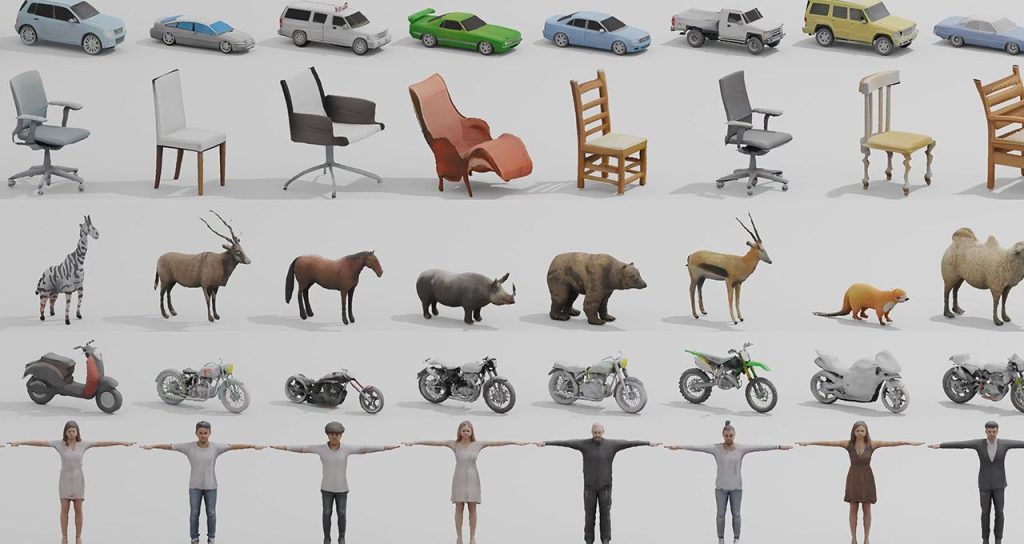
AI can support artists to create texture, generate concepts or even base mesh. While this speeds up early stages of production, most professional pipelines still rely heavily on manual work for final assets. Because production environments demand consistency, control and reusability. AI-generated assets often lack the precision and predictability required for large-scale projects.
What’s AI limitations in production?
Despite its advantages, AI comes with critical limitations that prevent it from replacing traditional workflows entirely.
AI doesn’t recover data – it predicts it
AI-generated detail is not “real” data, it’s an educated guess. This works well in many cases, but can become problematic when accuracy matters. For example, in product visualization, close-up shots, photorealistic materials, even small inaccuracies can break realism in high-end production.
Lack of stability across frames
AI performs well on still images, but struggles with animation. Common issues include flickering, temporal inconsistency and detail shifting between frames.
In professional pipelines, output must be predictable and repeatable – something AI still struggles to guarantee.
No understanding of artistic intent
AI can optimize pixels, but it doesn’t understand storytelling. mood, composition or art direction. A visually sharp image is not necessarily a good shot. Artistic decisions still rely entirely on human judgment.
Will AI replace 3D and VFX artists?
The short answer: No but it will redefine their roles.
AI will not replace creative thinking, visual storytelling or artistic direction. However, it will replace repetitive manual tasks, technical cleanup work, and time-consuming processes. In other words, AI is shifting the industry from execution-heavy work to decision-driven work.
Artists who rely solely on technical repetition may struggle. Those who develop strong artistic and problem-solving skills will become even more valuable.
The future: Hybrid workflows
The industry is not moving toward “AI vs traditional methods.” Instead, it’s embracing a hybrid approach.
In practice, this often means rendering with lower samples using traditional techniques, then applying AI for denoising, compositing, and final upscaling when needed. In this setup, AI does not replace the core workflow but acts as an optimization layer that enhances efficiency without sacrificing structure.
Final Thoughts
AI is neither a magic solution nor a direct threat to the 3D and VFX industry – it is a powerful tool whose value depends entirely on how it is used. The real challenge lies in knowing where to integrate AI without compromising quality, consistency, and control.
The artists who will thrive are not those who resist AI or rely on it blindly, but those who understand when to use it, when to trust traditional methods, and how to maintain creative authority over the final result because while AI can accelerate the process, only humans can give the work meaning.
See more:
All About AI Rendering in Architecture

No comments