


D5 Introduces an AI-Powered End-to-End Workflow for 3D Design
As generative AI continues to move beyond text and images into spatial and 3D domains, one of the biggest challenges remains translating human intent into complex visual environments. Describing how a space should feel—its light, atmosphere, materials, and context—has traditionally required hours of manual setup, iteration, and technical adjustment.
D5 Render has announced a new AI-driven approach to 3D design that aims to close that gap. With the release of D5 Render 3.0, the company introduces an AI Agent designed to interpret high-level creative intent and convert it directly into actionable 3D scene changes, bringing natural language, image-based prompts, and semantic iteration into real-time visualization workflows.
Rather than positioning AI as a standalone generator, D5 integrates AI as a continuous layer that carries design intent forward—from early ideation through final delivery.
Table of Contents
From Early Ideas to Visual Clarity
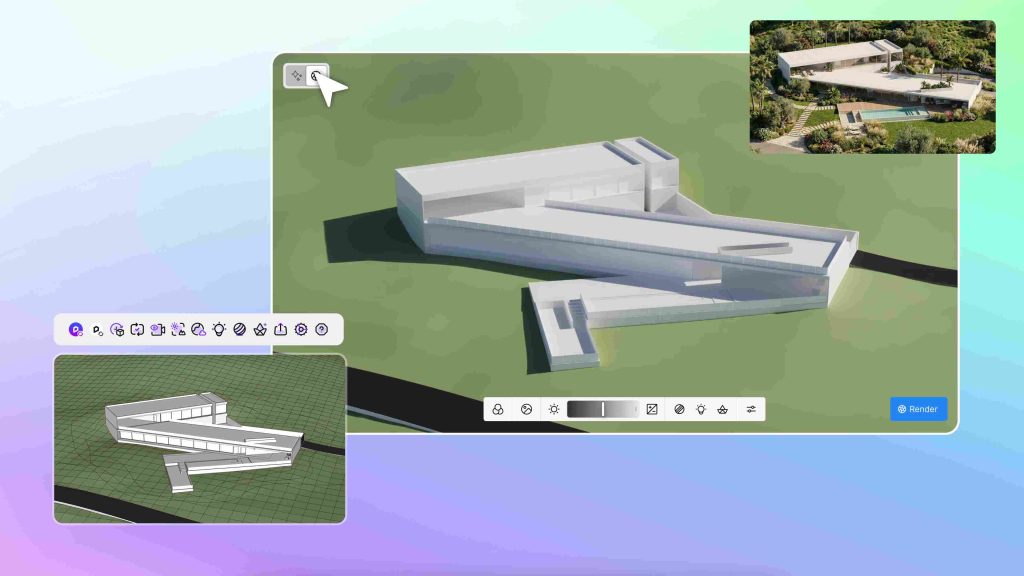
The workflow begins with conceptual exploration, where ideas are still fluid and decisions are intentionally lightweight. Working directly inside SketchUp through D5 Lite, designers can move from raw geometry to real-time visual feedback almost instantly. AI assists by translating high-level intent—such as mood, lighting direction, or time of day—into readable visual conditions, reducing setup friction and encouraging rapid exploration.
At this stage, AI functions as an accelerator for thinking rather than a driver of outcomes. Designers iterate freely, test alternatives, and align internally without committing to production-grade detail.
Building Context Without Losing Momentum
As design intent becomes clearer, scenes gain meaning through context. Population elements, environmental cues, and spatial references are introduced to communicate scale, use, and narrative clarity. AI continues to assist by supporting context-aware discovery and iteration, helping designers maintain momentum without interrupting focus.
The emphasis remains on legibility rather than realism—ensuring the design reads clearly as a place before visual fidelity becomes a priority.
From Exploration to Decision
As projects progress, environmental choices move from experimentation to intention. Lighting, sky conditions, and atmospheric tone are refined semantically, allowing designers to adjust visual direction through intent-based inputs rather than manual parameter tuning.
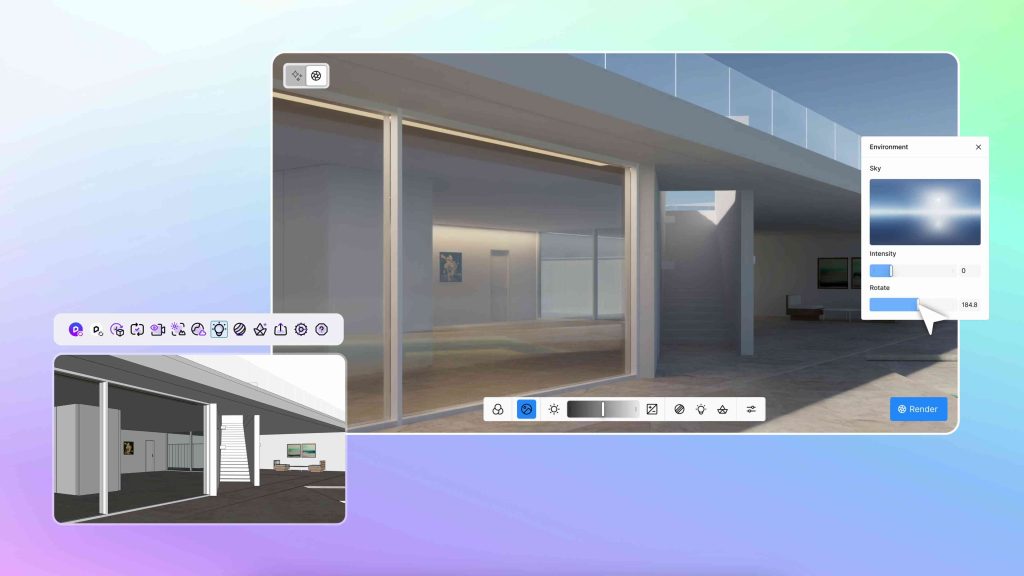
This marks a key transition point in the workflow. Once atmosphere and direction are agreed upon, the project moves from exploration into execution—without resetting or rebuilding the scene.
Professional Visualization and Final Delivery
When visual accuracy and presentation quality become critical, the workflow transitions seamlessly into D5 Render. All earlier decisions—materials, lighting, assets, and atmosphere—carry forward intact.
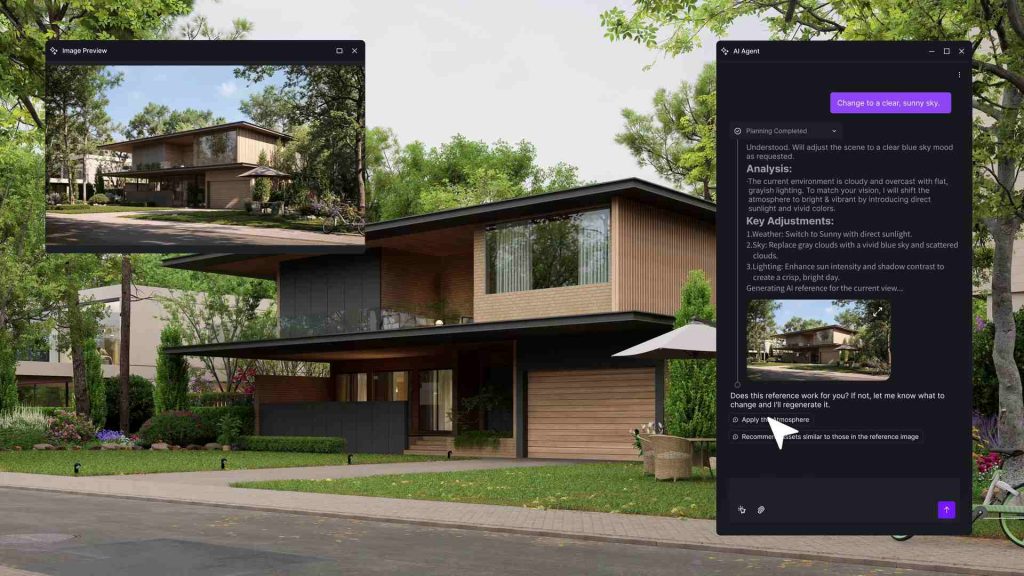
In this final phase, AI shifts into a supporting role, assisting with refinement, material behavior, lighting accuracy, and visual consistency. Designers retain full control over composition and storytelling, while AI helps manage complexity and reduce repetitive refinement.
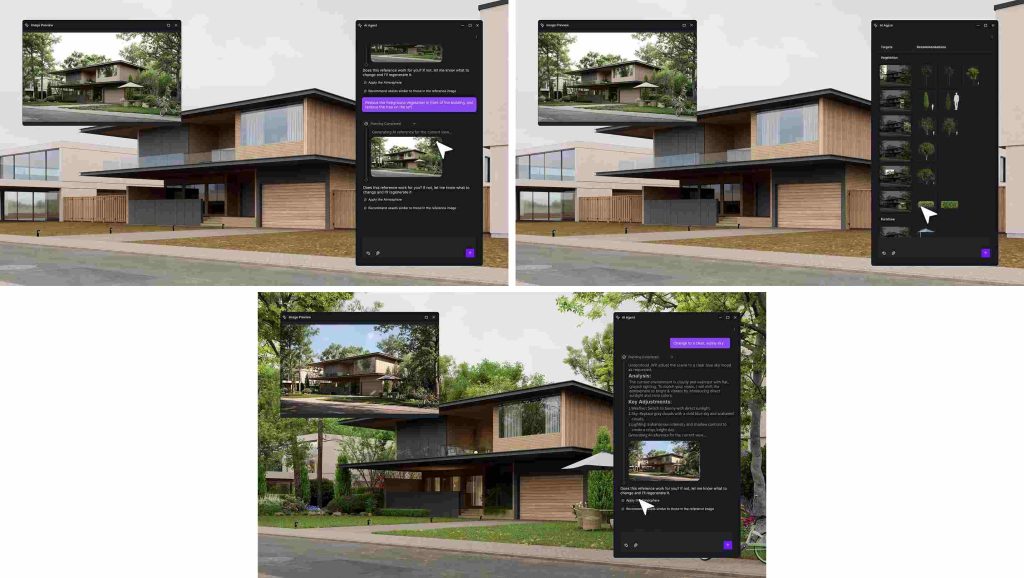
The result is professional-grade stills, animations, and presentations that reflect original design intent without translation loss.
One AI System, Multiple Roles
What distinguishes D5’s approach is continuity. AI does not reset between phases or generate disconnected outputs. Instead, it evolves alongside the project—supporting ideation when ideas are fragile and precision when ideas must endure.D5 Lite and D5 Render are designed as consecutive phases of the same AI-powered system, enabling teams to move from concept to delivery without breaking creative flow.
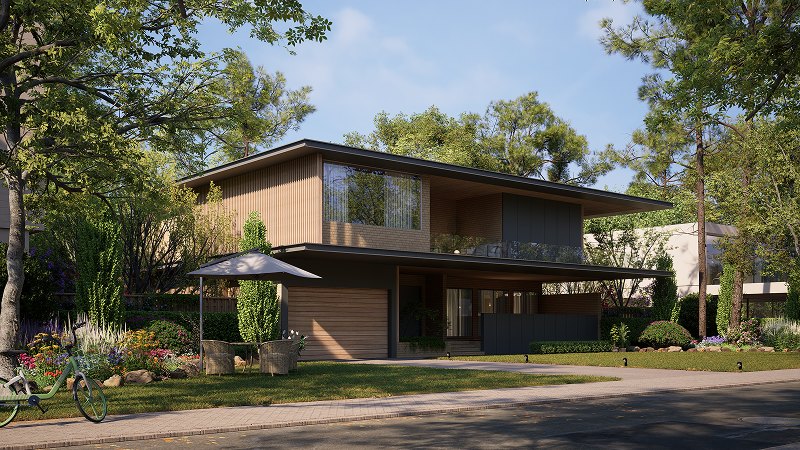
A Shift Toward Intent-Driven Design Workflows
With D5 Render 3.0, the company signals a continued investment in AI as a foundational layer of its platform. Future development will focus on expanding semantic control, improving multimodal understanding, and deepening integration between AI-driven tools and real-time visualization.
The goal now isn’t to automate creativity. It’s to remove the friction between ideas and execution so designers can work at the speed of thought, not the speed of software.
As AI continues to reshape how digital content is created, D5’s AI Agent represents a step toward a more intent-driven future: one where describing what you want becomes as important as knowing how to build it.

No comments